Tree Service in Franklin, KY
Removal, pruning, stump grinding, and storm work for homes, farms, and roadside trees in Franklin and the surrounding Simpson County countryside, just south of Bowling Green.
Call (270) 780-3310 for a Free Quote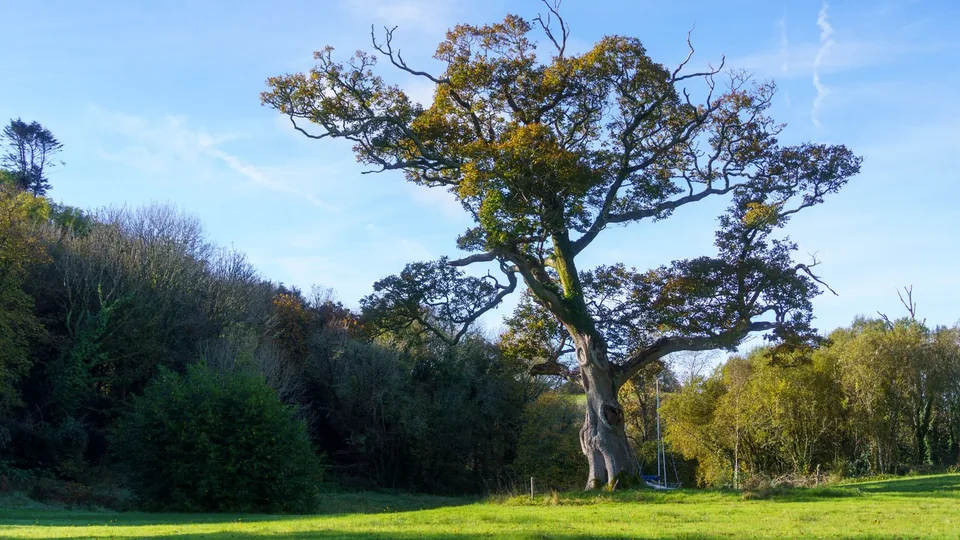
Franklin sits in open, rolling farm country south of Bowling Green, and its trees reflect that setting. There are the shade trees around older homes and along the town’s established streets, and then there is everything out on the farms — windbreaks, fence-line trees, lane and roadside trees standing alone in the open where the weather gets at them from every direction. Each calls for a different eye, and the work here spans both.
The open ground is the defining local factor. A tree in the middle of a field or along an exposed lane takes the full force of a straight-line wind with nothing around to break it, and that steady exposure shapes both how these trees grow and how they fail. Combined with the shallow rooting that comes with this region’s thin soils over rock, an exposed rural tree is a candidate for the kind of whole-tree wind failure that a sheltered in-town tree rarely sees.
Farm and Fence-Line Trees
Working farmland comes with its own tree list: windbreak rows that have grown ragged, fence lines swallowed by volunteer saplings and briars, dead and dying trees standing in pasture where livestock and equipment pass, and the big old shade tree by the barn that has seen better decades. This is practical tree work — clearing what is in the way, taking down what has become a hazard to fences and stock, and keeping the useful trees sound.
Fence-line clearing in particular is a recurring job out here, where a boundary can disappear into a strip of scrub and small trees over a few seasons. Cutting that back, removing the trees crowding or lifting the fence, and dealing with the brush restores the line without tearing up more than needed. It is the same selective approach a building lot gets, run along a boundary.
Mature Trees Around Older Homes
Franklin’s established neighborhoods and farmhouses carry a good stock of mature hardwoods, and those large, long-standing trees are worth the care that keeps them safe and sound. Clearing deadwood, lifting limbs off roofs and drives, and thinning a heavy canopy so wind passes through it are the everyday jobs that keep an old shade tree an asset instead of a liability.
When one of these trees does reach the end — from age, storm damage, or decline — taking it down near a house calls for the careful, piece-by-piece approach rather than a straight fell, even where there is more room than in a city yard. The value in the work is doing it without leaving a mark on the home, the outbuildings, or the trees staying behind.
Storms on Open Ground
When a front comes through this part of the county, the open landscape means trees catch the wind hard, and the after-storm calls run to whole trees down, uprooted trees with heaved root plates, and big limbs torn out of exposed canopies. Storm-loaded wood is under tension and unpredictable to cut, so this is work to leave to a crew that reads it first rather than something to tackle with a saw the morning after.
A fair amount of that damage traces back to deadwood and weak structure that a prune would have caught, which is the argument for keeping exposed trees cleaned up before the season rather than cleaning up after them. And any tree tangled with a power line along a rural road is the utility’s call first, every time.
Storm-hit or hazardous trees are handled on the emergency and storm damage page; routine care lives under tree trimming.
Services We Offer in Franklin
Frequently Asked Questions
Do you come down to Franklin from Bowling Green?
Yes. Franklin and the surrounding Simpson County countryside are part of the regular service area, just south of Bowling Green. Whether it is a single yard tree in town or work spread across a farm, a call sets up a free on-site estimate.
Can you clear an overgrown fence line on my farm?
Yes, and it is common work out here. Fence lines fill in with saplings and briars fast, so we cut the line back, pull the young trees pressing on the wire, and deal with the brush however you want it — chipped, hauled, or piled. It is selective clearing run along the boundary.
A big tree by my old farmhouse is half dead. Can it be saved?
It depends on how much is gone and where. A tree that dropped a few limbs but still has a solid trunk and crown can often be shaped back to something safe; one failing at the base or through the trunk usually cannot. You get a straight read on site, not a phone guess, and it comes down near the house only if that is truly where things stand.
Why do trees out in the open seem to blow over here?
Two reasons stack up. Exposed trees in open farm country take the full push of a straight-line wind with nothing to shelter them, and the region’s thin soils over limestone leave roots shallow and less firmly anchored. Together, that makes whole-tree wind failure more likely on an exposed rural tree than on a sheltered one in town.
A storm knocked a tree onto the fence and it is near a wire. What now?
If any part of it is touching a power line, call your electric utility first — a tree on a line is their specialized work and never a job to approach yourself. Keep clear of the tree, since storm-loaded wood is under tension. Once the power side is safe, we handle getting the tree off the fence and cleaning up.
Free Tree Service Estimate in Franklin
Free, no-obligation estimates across Warren County. Tell us about the tree, the stump, or the storm damage.
Call (270) 780-3310Prefer to send it in writing? Call (270) 780-3310 and we’ll get right back to you.